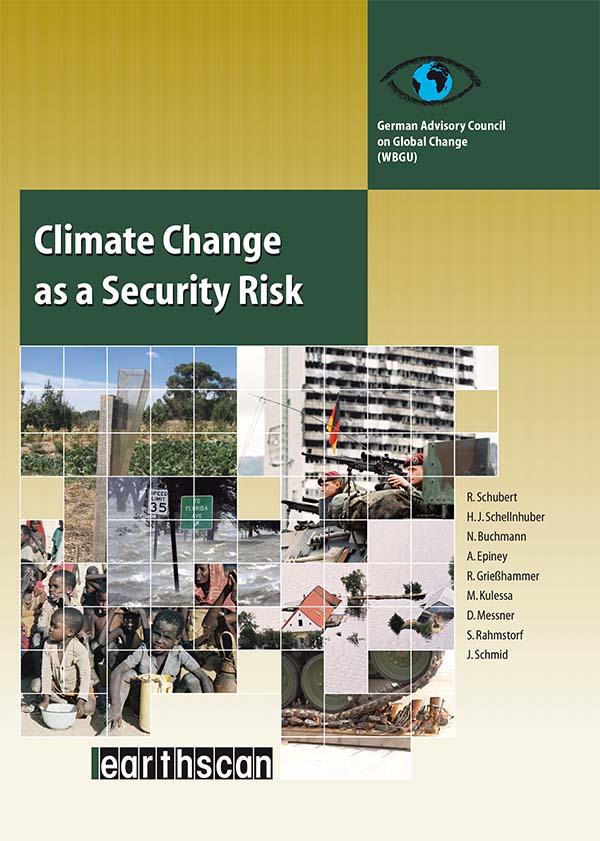
World in Transition: Climate Change as a Security Risk
Without resolute counteraction, climate change will overstretch many societies’ adaptive capacities within the coming decades. This could result in destabilization and violence, jeopardizing national and international security to a new degree.
Overview
However, climate change could also unite the international community, provided that it recognizes climate change as a threat to humankind and soon sets the course for the avoid-ance of dangerous anthropogenic climate change by adopting a dynamic and globally coordinated climate policy. If it fails to do so, climate change will draw ever-deeper lines of division and conflict in international relations, triggering numerous conflicts between and within countries over the distribution of resources, especially water and land, over the management of migration, or over compensation payments between the countries mainly responsible for climate change and those countries most affected by its destructive effects.
More about this topic
More on the Subject
Voices to this Report
"With Climate Change as a Security Risk, WBGU has compiled a flagship report on an issue that quite rightly is rising rapidly up the international political agenda. The authors pull no punches on the likelihood of increasing tensions and conflicts in a climatically constrained world and spotlight places where possible conflicts may flare up in the 21st century unless climate change is checked. The report makes it clear that climate policy is preventative security policy."
Achim Steiner, Executive Director of the United Nations Environment Programme (UNEP) (2006 – 2014)
PDF-Downloads
Welt im Wandel: Sicherheitsrisiko Klimawandel
- Download: Vollversion (PDF, 22 MB)
- Download: Kurzfassung (PDF, 2 MB)
World in Transition: Climate Change as a Security Risk
- Download: Full Version (PDF, 20 MB)
- Download: Summary (PDF, 2 MB)
Commissioned Expert's Studies
- Download: Brauch: Regionalexpertise: Destabilisierungs- und Konfliktpotential prognostizierter Umweltveränderungen in der Region Südeuropa und Nordafrika bis 2020/2050. (PDF, 5 MB)
- Download: Carius, Tänzler, Winterstein: Weltkarte von Umweltkonflikten: Ansätze zur Typologisierung. (PDF, 2 MB)
- Download: Cassel-Gintz: Karten zur Bodendegradation und Versalzung. GIS-II. (PDF, 20 MB)
- Download: Clark: Environmentally Induced Migration and Conflict. (PDF, 2 MB)
- Download: Giese, Sehring: Regionalexpertise: Destabilisierungs- und Konfliktpotential prognostizierter Umweltveränderungen in der Region Zentralasien bis 2020/2050. (PDF, 2 MB)
- Download: Heberer: Regionalexpertise: Destabilisierungs- und Konfliktpotential prognostizierter Umweltveränderungen in China bis 2020/2050. (PDF, 1 MB)
- Download: Swatuk: Regionalexpertise: Southern Africa, Environmental Change and Regional Security: An Assessment. (PDF, 1 MB)
- Download: (Wodinski: Karten zu Umweltparametern. GIS-I Diese Expertise betraf die Zulieferung von Daten bzw. das Rechnen von Modellläufen, so dass das Ergebnis nicht oder nicht ausschließlich in Schriftform vorliegt.)
- Download: Wolf: A Long Term View of Water and Security: International Waters, National Issues, and Regional Tensions. (PDF, 1 MB)